Sunday, September 26, 2010

An Intro to Haibun

photo source: http://www.flickr.com/photos/14485539@N00/2354473497


I haven't written any poems in awhile. There have been several lines bandying their way through my brain lately but nothing more than that. Just not enough time, I guess. I was intrigued by this week's prompt at Big Tent Poetry, though, so I thought I'd try to find my muse.

The challenge--write a haibun, a composition that combines prose and haiku. The catch--the haibun is supposed to be a travel log. And not just a travel log, but a log of a trip on which you encounter a mythical creature.

Sounds daunting, I know, but I actually had some fun with it. I just sat down and pounded it out, so I'm sure it's a bit rough. But getting something down on paper felt good. I'd never tried to write a prose poem before. I'm not sure if there are rules, but I'm pretty sure there aren't.

As for my quest, I chose a Chimera, a hideous beast known for breathing fire and being an omen of natural disaster. I think I chose it at random, from a Wikipedia list of Greek mythical creatures, although an analysis of my subconscious may reveal otherwise. I don't know. I think I just like the sound of the word chimera.

I pictured a group of warriors out on a journey for weeks and weeks, tracking this beast. Not in hopes of killing her, but in hopes of maybe taming her or at the very least figuring her out. It doesn't end that well, but I tried to contrast the failure of their mission with a more optimistic closing haiku. So, here you go...

Chimera

That cirrus-framed rectangle of the faintest blue ripped in the graying sky was our signal. This ill-fated quest had come to an end, its apocalypse a product of hubris and fate, of misfortune and audacity, and now it was time to end it, to let it all go, to heed the warning and follow our instincts. Away. Away from this washed out villa of mistaken tranquility and inebriated lust, of foolish clingings to time-gone-by and memories of strength no longer possessed. The rectangular gateway: our omen, our message to flee, our oncoming storm, our subconscious--emphasized more by the searing, uncontrollable fires of the Chimera, the very beast we sought to tame, to deconstruct, to make sense of. The very beast incapable of capture (we knew this all along). The very beast that set us on this path.

the four sided sign
of what will never be true
the blueness of hope


Saturday, September 25, 2010

Poetry Mix Tape: Ordinary Things

I try to start my year with poems students will enjoy. When they come to me, their exposure to good poetry is fairly limited. So what I want to help them do is realize how fun poetry is. I do this with some silly rhyming poems, but also with poems that have poetry moves that they can easily understand and enjoy, moves like metaphor and repetition and multiple meanings. (I used Hughes to talk about a lot of these things).

Now, I like to hit them with free verse and show them that poetry can truly be about anything. Check that. Not just anything. But ANYTHING. There are no limits really, I tell them, when it comes to where poems "hide."

In that spirit, for the next few weeks we'll be reading poems about everyday, commonplace, mundane, and ordinary things. This Mix Tape may be the easiest to add to for the wonderful readers out there. So feel free to comment and contribute more poems. But here's my Mix Tape of poems about ordinary things, also known as poems that make the ordinary seem extraordinary...

The Red Wheelbarrow by William Carlos Williams
Between Walls by William Carlos Williams
Daddy Longlegs by Ted Kooser
Gas Pump by Jed Chambers (can't find this one anywhere but here -- scroll down to find it)
Safety Pin by Valerie Worth
Ode to My Socks by Pablo Neruda
To Television by Robert Pinsky
The Broken Sandal by Denise Levertov
The Heron by Linda Hogan

And finally, I'm not sure if this qualifies, but it is a poem about an ordinary situation involving ordinary things. And it paints a vivid, beautiful picture of the situation...


In the Basement of the Goodwill Store

BY TED KOOSER
In musty light, in the thin brown air   
of damp carpet, doll heads and rust,   
beneath long rows of sharp footfalls   
like nails in a lid, an old man stands   
trying on glasses, lifting each pair
from the box like a glittering fish   
and holding it up to the light
of a dirty bulb. Near him, a heap   
of enameled pans as white as skulls   
looms in the catacomb shadows,   
and old toilets with dry red throats   
cough up bouquets of curtain rods.

Read the rest at the Poetry Foundation, please. And, of course, add your favorite "ordinary" poems in the 
Comments.

Is Poetry Going Mainstream?

I pride myself on liking things that other people would find obscure, quirky, or maybe even "off-beat." Things that would definitely be considered outside of the mainstream. Take Twitter for example. Twitter was awesome when nobody had heard of it, when you would mention it to someone and then have to spend 15 minutes explaining its appeal (all the while silently mocking their un-quirkiness err I mean un-coolness). But Twitter has certainly jumped the shark. Not sure when it happened, but it did (maybe it was when Wal-Mart started tweeting) and now I'm over it.

Same thing with music. I first saw 311 in 1994 on the second stage of a local radio station's fall music festival. They were amazing. Shortly thereafter, they hit it big--radio, MTV, etc. I lost interest. (The fact that their music got exponentially worse after their debut album did help matters, though). The Hard Lessons is a local band that has put out some really great music. But when I saw that a teacher at work had a "Hard Lessons" sticker on her file cabinet, I somehow felt less cool. I sure hope Dale Earnhardt Jr. Jr. doesn't hit it big anytime soon.

Well now it seems that poetry is getting more pub of late. I recently wrote about The Anthologist, a terrific novel I just read. And this week I just learned of a novel called The Financial Lives of Poets. Looks pretty interesting; I'll definitely be reading it. Here's the "book trailer" from Harper Books:


And then there's Howl, a new movie starring James Franco as Allen Ginsberg that looks pretty intriguing. I'm not much of a beat poet fan (although I do enjoy the occasional Ferlinghetti poem), but it's hard to resist a movie about a poet and one of his signature poems.  Here's the trailer:


Despite all this, I'm not really worried about poetry taking a dip in the mainstream. In fact, I'm happy. Spread the gospel, that's what I say. The more people reading, writing, teaching, and seeing movies and reading books about poetry the better. It's one thing I love that I'm more than happy to share with others without affecting my twisted outlook on coolness and quirkiness and shark jumping and the like. And in the spirit of spreading the gospel, here is a Ginsberg poem I really like, "A Supermarket in California."

A Supermarket in California
By Allen Ginsberg


  What thoughts I have of you tonight, Walt Whitman, for I walked 
down the sidestreets under the trees with a headache self-conscious looking 
at the full moon.
  In my hungry fatigue, and shopping for images, I went into the neon
fruit supermarket, dreaming of your enumerations!
  What peaches and what penumbras!  Whole families shopping at 
night!  Aisles full of husbands!  Wives in the avocados, babies in the tomatoes!
--and you, GarcĂ­a Lorca, what were you doing down by the watermelons?

  I saw you, Walt Whitman, childless, lonely old grubber, poking
among the meats in the refrigerator and eyeing the grocery boys.
  I heard you asking questions of each: Who killed the pork chops?    
What price bananas?  Are you my Angel?
  I wandered in and out of the brilliant stacks of cans following you,
and followed in my imagination by the store detective.
  We strode down the open corridors together in our solitary fancy 
tasting artichokes, possessing every frozen delicacy, and never passing the 
cashier.

  Where are we going, Walt Whitman?  The doors close in a hour.
Which way does your beard point tonight?


I do love poem by Whitman, but a poem featuring Whitman as a character is pretty awesome, too. You can read the rest of the poem here--you can even listen to Mr. Ginsberg read it himself.

So enjoy your time in the mainstream, poetry. I hope you wear a life preserver--the undertow has been known to do some wicked damage.

Tuesday, September 21, 2010

Starting With Hughes

If forced to choose a favorite poet to use to teach poetry to young children, I think I'd have to go with Langston Hughes. His poems are filled with brilliant metaphor, rich language, strong rhythms and sounds--all the things I want to expose to young readers of poetry. Not only that, but they're steeped in history. To read and understand Hughes, you must understand his times--where and when he was from. His poems give me the opportunity to teach students about those times. And I really think his poems are way better at bringing those times to life than any textbook could ever be.

So last week I started with "Dreams," one of my all-time favorites and maybe Hughes's most widely known poem. Today we looked at one that's slightly less famous, although it does lend its title to the title of a great collection of his poems which every teacher should own, "The Dream Keeper." It goes like this:

Bring me all of your dreams,
You dreamers, 
Bring me all of your
Heart melodies
That I may wrap them
In a blue cloud-cloth
Away from the too-rough fingers
Of the world.
Only eight lines, yet so poignant. At least in my mind. In case you're wondering, I also enjoy and will probably teach at some point this year "Mother to Son,"  "I, Too," "Dream Variations," and "Dream Deferred." (What can I say? I'm a sucker for Dream poems). Of course, I've already talked about how I used two of his other poems, and I'd also say that if I taught high school, I'd teach "Theme for English B" for sure.

I'll leave with a short one that I discovered, simply called "Poem." I'll be sharing it tomorrow with my students to see what they think and to talk about the joy of repetition in poems (definitely a topic for future posts)...

I loved my friend 
He went away from me 
There's nothing more to say 
The poem ends, 
Soft as it began- 
I loved my friend

Saturday, September 18, 2010

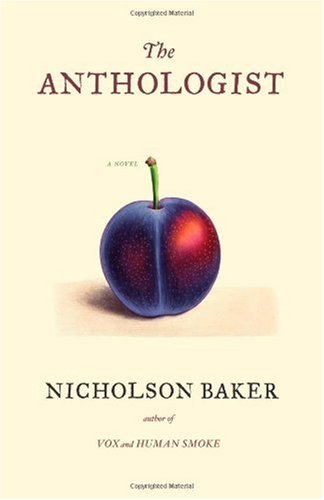
A Novel About Poetry: The Anthologist


I certainly haven't been doing much reading these last few weeks--the return of the school year has certainly slowed me down. However, I am still trying and this week I finished a novel about poetry. I know, who would've thought such a thing could exist? I certainly haven't encountered anything like it before. It turned out to be a really good read and a novel that works on so many levels that I'm sure I missed a lot. I might even have to re-read it to examine the nuances more closely. Either way, I highly recommend it. It's called The Anthologist and it's written by Nicholson Baker.

I'm always amazed when an author uses a premise that's completely unique and new. Baker seems to do that over and over, whether in his novel about a man who's able to press a magical pause button at various points during the day, The Fermata, or his novel about phone sex, Vox (yeah, I read it. I'll leave it at that). And just like in those books, the story of The Anthologist is about more than just the obvious. Like these others, it's about life, love and the human condition. And, also like the others, once you start reading, it's difficult to stop.

In The Anthologist, Tom Chowder, a slightly-less-than-successful poet, is charged with writing an introduction to a poetry anthology he has put together. Told from Chowder's point of view, we get to follow along as he struggles to write the introduction, as he laments about the demise of rhyme in poetry, and as he struggles with the loss of his true love (who left, in part, over her frustration with his inability to complete the introduction). Interwoven in the story are Chowder's analyses of poems, background information about poets well-known and not-so-well-known, and lots of name dropping...even poetry scholar Helen Vendler's name is mentioned!

I definitely recommend this novel and I'd love to hear what you think of it. And if you know of any other poetry-themed novels, please share. Now if you'll excuse me, I'm 150 pages into The Passage, Justin Cronin's exquisitely well-written vampire novel and I can't tear myself away.

Tuesday, September 14, 2010

The Local Poetry Scene (or lack thereof)

So I was in Los Angeles this weekend--a place I've never been before--and I thought it would be interesting to see if there were any poetry events happening. After some quick searching I found that during any given week in L.A. there are tons of readings and open mic nights. None of them worked for my timeframe, so I didn't get to check one out, but the abundance of choices left me feeling envious.

You see, I live in the Detroit area and from what I've found, the poetry scene here is not all that vibrant. If there's much of a scene at all, it's terribly under-publicized. Maybe I need to dig deeper. (If there are any Detroit poets out there reading this, let me know where I can go!) Who knows. I guess in a perfect world there would be readings to go to every night of the week. I guess I'm going to have to work on finding out more about local poets and local poetry so that I can get more involved.

On another note, I didn't do much reading while I was out of town. I did ponder doing a post of "Poems of L.A." but I didn't get very far in my research with that one. In the short amount of time I looked, I did come across a poem by Philip Levine, who just happens to be from Detroit. I think it's a poem more about California than Los Angeles, but since I'd never been to either before Friday, I think it'll do. On top of that, it's a great poem, too.
Gospel 
by Philip Levine

The new grass rising in the hills,
the cows loitering in the morning chill,
a dozen or more old browns hidden
in the shadows of the cottonwoods
beside the streambed. I go higher
to where the road gives up and there's
only a faint path strewn with lupine
between the mountain oaks. I don't
ask myself what I'm looking for.
I didn't come for answers
to a place like this, I came to walk
on the earth, still cold, still silent.
Still ungiving, I've said to myself,
although it greets me with last year's
dead thistles and this year's 
hard spines, early blooming
wild onions, the curling remains
of spider's cloth. What did I bring 
to the dance? In my back pocket
a crushed letter from a woman
I've never met bearing bad news
I can do nothing about.

Enjoy the rest of "Gospel" here. Let me know how you like it.

Saturday, September 11, 2010

Lest We Forget

I'm sitting in a hotel lobby. CNN is on the television. Nine years later, the 9/11 tributes and remembrances are still nearly too upsetting for me to watch. But it's still on my mind. The complete confusion of that day. The tragedy of it all. Nine years but it doesn't even seem like one. So many things have happened to me since and so many of them I have barely any memory of...but that day is seared in my memory. I remember where I was. I remember where I went out to dinner to try to escape it all. I remember the CD I bought at the only store around that was open. I wasn't trying to disrespect the pain and sadness of the moment by doing normal, mundane things. I just didn't know what to do. I just knew I couldn't sit there and watch any more of it on television. I had already been watching for eight hours straight. I couldn't take anymore.

So today I pay my own little tribute to the innocent victims of that day. I didn't know any of them. But I feel connected to them all. Maybe you know this poem, maybe not, but it deserves (or maybe commands) your attention today. Its sweeping language and vivid imagery--it's a work of art and I hesitate to call it beautiful because I don't know if that's the world. But I will call it perfect, because I think it is.

Alabanza: In Praise of Local 100 
by MartĂ­n Espada

for the 43 members of Hotel Employees and Restaurant Employees Local 100, working at the Windows on the World restaurant, who lost their lives in the attack on the World Trade Center 
Alabanza. Praise the cook with the shaven head
and a tattoo on his shoulder that said Oye,
a blue-eyed Puerto Rican with people from Fajardo,
the harbor of pirates centuries ago.
Praise the lighthouse in Fajardo, candle
glimmering white to worship the dark saint of the sea.
Alabanza. Praise the cook's yellow Pirates cap
worn in the name of Roberto Clemente, his plane
that flamed into the ocean loaded with cans for Nicaragua,
for all the mouths chewing the ash of earthquakes.
Alabanza. Praise the kitchen radio, dial clicked
even before the dial on the oven, so that music and Spanish
rose before bread. Praise the bread. Alabanza.

Praise Manhattan from a hundred and seven flights up,
like Atlantis glimpsed through the windows of an ancient aquarium.
Praise the great windows where immigrants from the kitchen
could squint and almost see their world, hear the chant of nations:
Ecuador, México, Republica Dominicana, 
Haiti, Yemen, Ghana, Bangladesh.
Alabanza.
 Please take the time to read the rest of the poem here. Thanks for reading today. I appreciate it.